Language Builders Programme
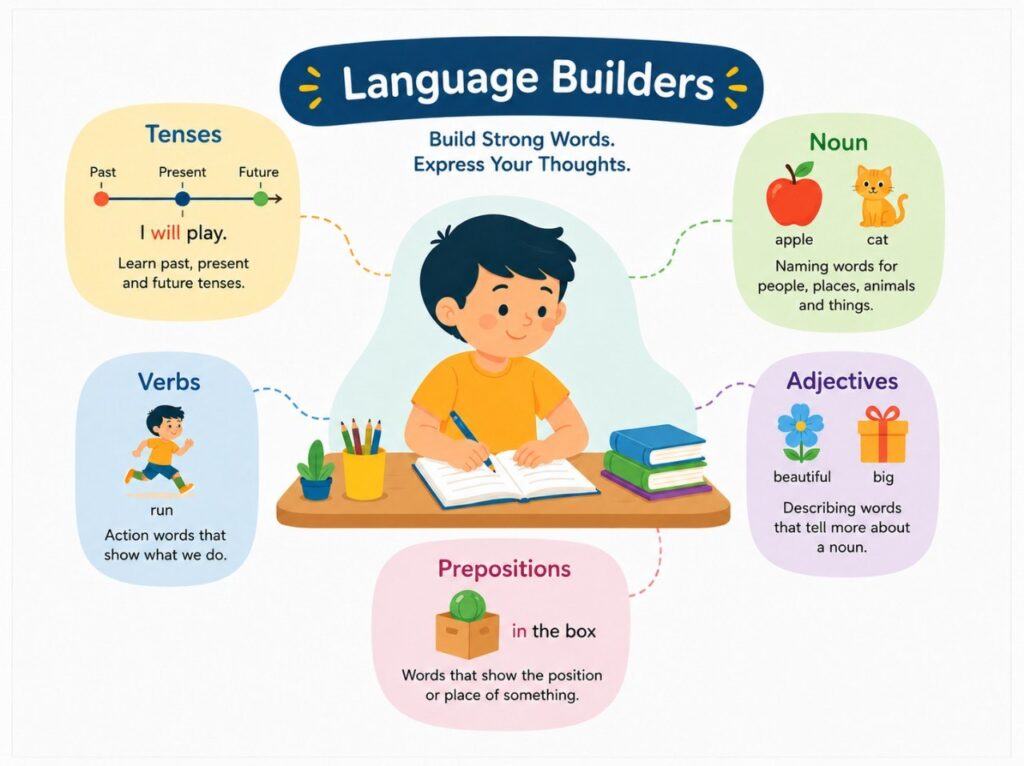
Where language takes shape. Our Grammar programme takes the reading foundation and builds the rules on top of it — nouns, verbs, adjectives, tenses, punctuation and more — one confident level at a time. Children don’t memorise rules here. They understand why they work.
How sessions work
Every session is built to stick.
Small Learning Groups
All sessions take place in small, cosy groups or fully 1-on-1 — so every child gets genuine, individual attention and no one is ever left behind.
Consistent Weekly Schedule
Regular sessions every week maintain the momentum of phonics acquisition. Consistent exposure is what turns sounds into automatic, fluent reading.
Colour-Coded & Multisensory
Parts of speech are taught using distinct colours and actions — nouns, verbs, adjectives each have their own anchor.
Live Online — Anywhere
All sessions are live video. I can see how your child responds and adapt every session to what they need that day.
The curriculum
6 Levels - Foundation to Advanced based on UK - based JOLLY Grammar curriculum
Level 1 · Spelling, Grammar & Punctuation
- Revision and extension of earlier phonics teaching
- Vowel digraphs
- Alternative spellings of vowel sounds
- Plural endings
- Short vowels and consonant doubling
- Tricky words
- Consonant blends
- Nouns (proper, common, and plural)
- Personal pronouns
- Verbs
- Verb conjugation (past, present, and future)
- Adjectives and adverbs
- Correct use of a, an, and the
- Sentences – capital letters, full stops, and speech marks
- Parsing – identifying the parts of speech in sentences
- Alphabetical order
Level 2 · Spelling, Grammar & Punctuation
- Revision of Grammar, Spelling & Punctuation 1
- Syllables
- Identifying the short vowels
- New spelling patterns (ei, eigh, ture)
- Silent letters (b, c, h, k, w)
- Spelling rules (consonant doubling and adding suffixes)
- Tricky word families
- Further adjectives – possessive
- Comparatives and superlatives
- Prepositions
- Conjunctions
- Punctuation
- Exclamation marks
- Apostrophes
- Dictionary skills
- Further sentence developmen
- Revision of elements covered in Spelling, Grammar & Punctuation 1 & 2
- New spelling patterns (tch, dge, ure, gn, gh, ex, n for /ng/, s for /z/, se/ze for /z/, a for /ar/, y for /i/, a for /o/, ere for /air/, eer/ere for /ear/)
- Suffixes – -less, -able, -ful
- Collective nouns
- Proper adjectives
- Nouns acting as adjectives
- Pronouns – subject, object, and possessive
- Subject and object in a sentence
- Present participle and the continuous tenses
- Contractions
- Questions and exclamations in speech
- Paragraphs
- Revision of elements covered in Spelling, Grammar & Punctuation 1, 2 & 3
- Nouns – concrete, abstract, and possessive
- Present participle as an adjective
- Infinitives
- Parsing verbs
- Agreements
- Clauses and independent clauses
- Sentence writing – statements, questions, and compound sentences
- Hyphens
- Onomatopoeia
- Synonyms and antonyms
- Homophones
- Revision of elements covered in Spelling, Grammar & Punctuation 1, 2, 3 & 4
- Irregular plurals
- Simple and continuous tenses
- Contractions and the verb “to have”
- Transitive and intransitive verbs
- Compound subjects and objects
- Adverb placement in sentences
- Adverbs of manner, degree, place, time, and frequency
- Prepositional phrases
- The order of adjectives
- Parenthesis
- Sentence Walls
- Proofreading
- Synonyms and antonyms
- Homophones
- Revision of elements covered in Spelling, Grammar & Punctuation 1, 2, 3, 4 & 5
- Prefixes and suffixes (especially numerical)
- New spelling patterns/rules – ough
- More spelling alternatives (they, great, ballet, fete, straight for /ai/)
- Silent letters – bt, te, th
- Schwas in suffixes
- Definite and indefinite articles
- New parts of speech: countableand uncountable nouns, gerunds and modal verbs, and imperatives
- Using semi-colons and colons,using a comma after a fronted adverbial
- Sentence structure, indirect objects, subject complements and passive agents
- Alliteration, idioms, formal/informal writing
Questions about Language Builders
Does my child need to complete Phonics first?
Ideally yes — Grammar builds on Phonics foundations. But if your child is already reading independently , they can often start Grammar directly. The free trial will confirm the right entry point.
Which level is right for my child?
The level roughly maps to school grade — but every child is different. I recommend the level based on what I observe in the trial, not just their age or class.
Why is Grammar important for children ?
Grammar is important for children because it helps them form correct sentences, communicate clearly, improve reading and writing skills, and build a strong foundation for effective language learning and academic success.
Book a free trial session — I will find the right level for your child and show you exactly how Language Builders works.